October 17, 2025
New York, Los Angeles, or Chicago?
Brandon McComas, Research Director
October 17, 2025
Brandon McComas, Research Director
October 17, 2025
Brandon McComas, Research Director
Ask any American to name the country’s top three cities to visit, and you’ll likely hear the same familiar lineup: New York, Los Angeles, and Chicago. It’s a debate that surfaces online every few months – about which city truly defines the U.S. tourism landscape – but beyond opinion, what does the data say? Using online search data from Google, we looked at how Americans have searched for these three cities as destinations to visit over the past few years. The results reveal that where – and when – people dream of visiting depends as much on season and geography as on the cities themselves.
When it comes to travel interest, timing is everything. Google search data show that Americans’ curiosity about visiting New York, Los Angeles, and Chicago follows a clear seasonal rhythm.
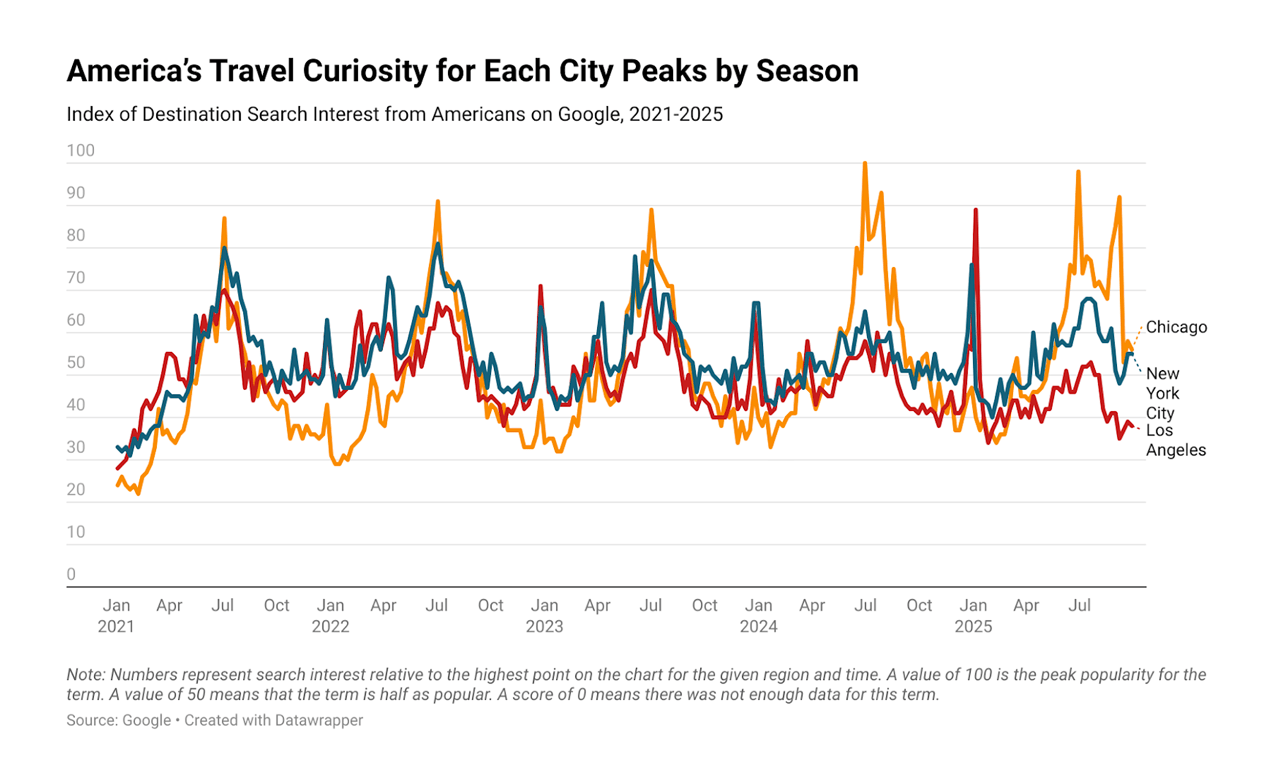
Chicago consistently peaks every summer, as its warm-weather months drive a surge in curiosity – particularly around June and July, when search interest climbs to its yearly highs. In contrast, New York City shines in December, its search index often hitting 60 or higher, with 100 being the max search interest for all three cities since 2021, as travelers look toward its iconic holiday season immortalized in song and on screen for more than a century.
Meanwhile, Los Angeles maintains steadier, mid-level interest throughout the year, rarely dipping below 40 or spiking above 55, reflecting its year-round appeal and fewer seasonal triggers.
These cycles show that America’s biggest cities are not only perennial favorites but also seasonal standouts, each dominating the national imagination at different times of year.
While all three cities remain household names in American tourism, Chicago’s momentum clearly stands out. Averaged annually, Chicago’s search interest relative to New York City and Los Angeles rose from 43 in 2021 to 57 in 2025 – a 33% increase over five years. During the same period, Los Angeles dropped from around 50 to 44, and New York increased modestly from 51 to 54, signaling a rebalancing in how Americans think about the nation’s urban icons.
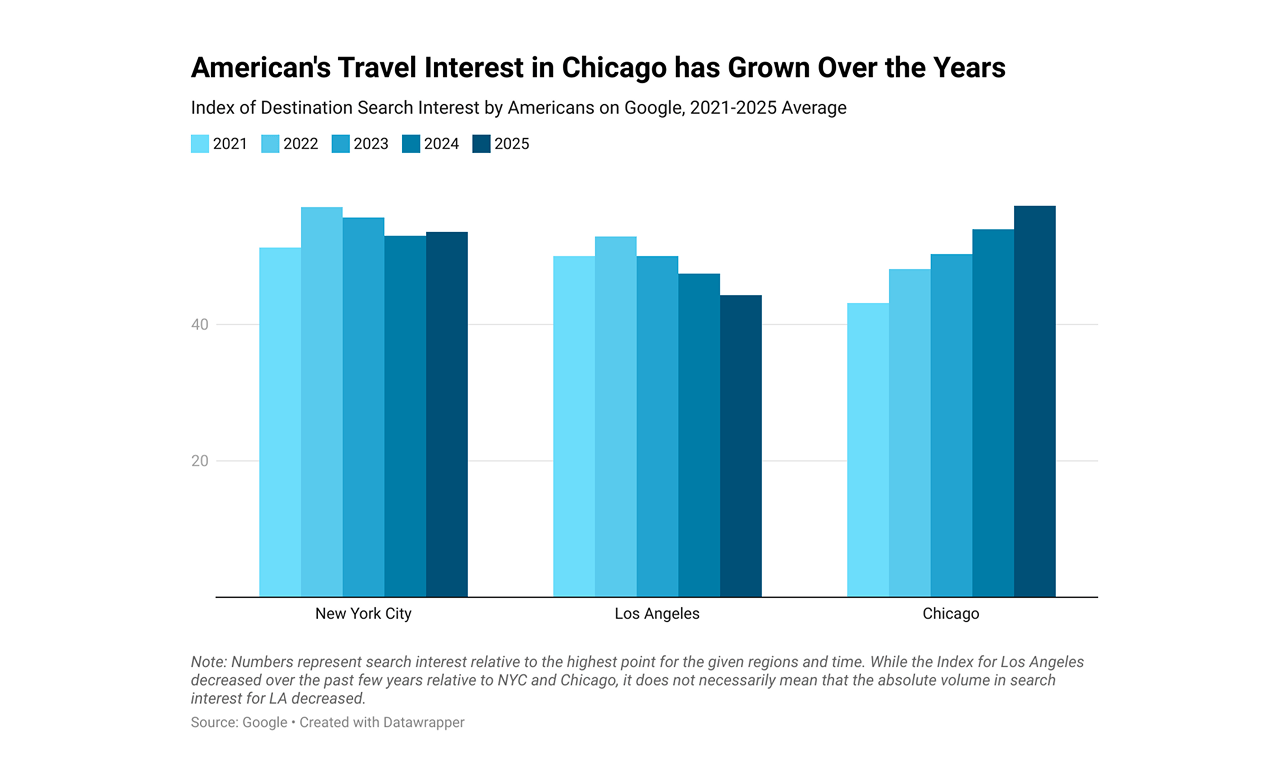
Part of this shift reflects the post-pandemic normalization of travel searches – the surge of 2022 leveling off as international and leisure options reopened – but it also speaks to Chicago’s growing pull as a domestic destination. The city’s strong summer profile, cultural events, and positive media coverage appear to have translated into sustained digital curiosity.
Data note: The indexed data in the chart above reflects search volume relative to New York City, Chicago, and Los Angeles. While Los Angeles’ indexed results have decreased, it does not necessarily mean that the search volume in Los Angeles has necessarily decreased, but rather that it’s decreased relative to the other two cities.
Geography plays a powerful role in how Americans think about travel. When search interest is mapped by state, clear regional loyalties emerge:
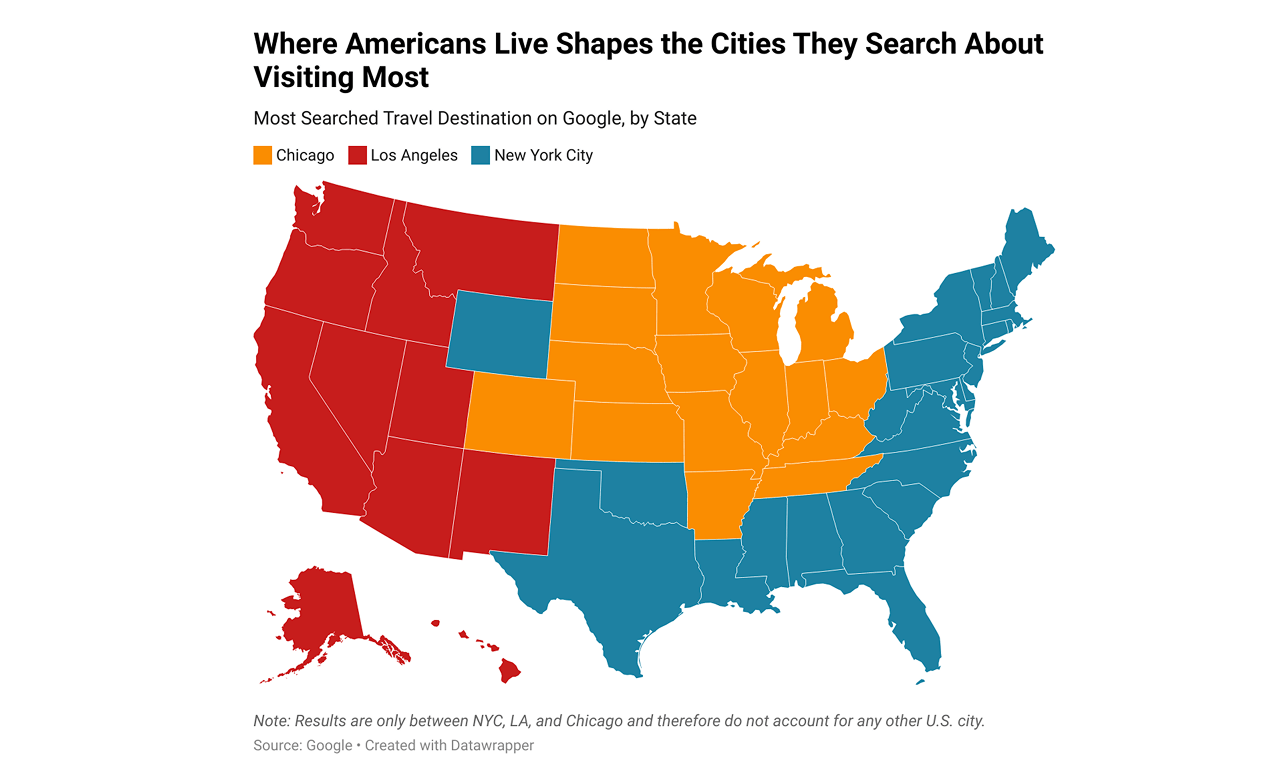
These patterns show that Americans tend to dream regionally. They’re most curious about destinations that feel both accessible and aspirational – the great city that represents their corner of the country. What starts as a national debate about the “top three” often maps neatly onto regional identity and pride.

The debate over America’s “big three” cities may never truly be settled – and maybe that’s the point. Each city’s rhythm of curiosity tells its own story: New York remains the cultural constant, Los Angeles continues to embody year-round wanderlust, and Chicago has become the momentum-driven city of the summer. Together, they anchor America’s urban imagination, each reflecting a different version of the American experience.
Of course, this analysis only looks inward. If we expanded the view globally – asking how travelers from abroad search for these same three cities – the rankings might look very different. That, perhaps, is a question for another story.